By Rashad Ahmadov | June 2026
Executive Summary
The U.S. is contracting decades of new thermal generation without seriously examining how that heat is converted. Source mix and permitting dominate the debate. The conversion cycle, the working fluid that determines how much of every fuel dollar becomes useful output, is treated as settled.
It is not. Recompression supercritical CO2 Brayton cycles deliver 45 to 50% thermal efficiency where advanced nuclear and gas plants operate, against 33 to 37% for the steam cycles those plants default to. The turbomachinery is roughly one-tenth the size at equivalent power. The cycle runs on dry cooling, which matters in Texas, Arizona, and the Mountain West where the new load is going. DOE demonstrated 4 MWe at full design conditions in October 2024 and is reconfiguring toward 10 MWe and 50% efficiency. China’s first commercial unit is already operating.
The plants being contracted today will run until 2070. The conversion technology is a 50-year decision being made by default. Four interventions change that: extend STEP toward utility scale, add a conversion-efficiency signal to existing tax credits, shift federal procurement to outcome-based specifications, and map the supply-chain gaps that drive first-of-kind cost premiums. None of these requires new authority. None requires a technology breakthrough. They require recognizing that the conversion layer is a strategic choice, and acting before the procurement window closes.
The Conversion Layer
Energy policy debates tend to converge on one question: where does the power come from? Fuel mix, generation source, carbon intensity. These matter. But the debates often frame the grid as having a supply problem and leave the conversion layer largely unexamined.
The conversion layer is the heat-to-wire step. Heat is produced, a working fluid carries it through a turbine, and the shaft drives either a generator or process equipment depending on the application. The thermodynamic properties of the working fluid and the operating conditions determine how much of the input heat becomes usable power. This is a design variable. It is also treated, in most procurement decisions, as a settled one.
Steam turbines have worked reliably for over a century. The supply chains, regulatory frameworks, and engineering standards are all built around them. Combined-cycle gas plants reach about 60% thermal efficiency by stacking a gas Brayton topping cycle on a steam Rankine bottoming cycle; the Rankine stage carries the same conversion-layer limits as any other steam plant. Nuclear, which lacks a high-temperature topping cycle, runs the steam stage alone and reaches 33 to 37% efficiency.[1] Both numbers are products of the working fluid and cycle architecture, chosen at design stage for assets that will operate into the 2070s.
This paper focuses on grid-connected thermal generation because that is where the largest near-term capital commitments are being locked in. The same conversion-layer logic applies, often more strongly, to industrial co-generation, process heat, and waste-heat recovery, where sCO2‘s compactness, heat-source flexibility, and dry cooling compatibility make those use cases natural early markets. DOE-funded sCO2 work spans waste-heat recovery and concentrating solar. The grid case has the 50-year procurement window, so that is where this argument concentrates.
The Atlas Institute’s work on the energy-industrial buildout, grid capacity constraints, and advanced nuclear deployment makes the conversion layer directly relevant to this institute’s mission. Advanced nuclear and fusion plants cannot reach their full economic and strategic potential if the technology converting their heat to electricity is the same one used in plants built in the 1970s. This paper argues that conversion efficiency belongs in the same policy conversation as generation source, permitting reform, and grid investment.
Steam’s Limits
A power cycle working fluid has one job: absorb heat, do work through a turbine, and return to the start of the cycle with minimum energy input. The cheaper that return step is, the more net output the cycle delivers.
Water does this well in many respects. High latent heat of vaporization, chemical stability, low cost, and more than a century of operational data. The infrastructure built around it (boiler, superheaters, condensers, feedwater heater trains) reflects those advantages.
The constraint is the critical point. Above 374°C and 22.1 MPa, water enters its supercritical phase, where liquid and vapor merge into a single dense fluid with favorable transport properties.[2] Accessing that regime requires both extreme temperature and extreme pressure simultaneously. The most advanced ultra-supercritical steam plants in commercial operation reach around 45% efficiency, bought with expensive alloy development and operation near the edge of current materials capabilities.[3] Further gains require materials that are not yet commercially available at scale.
There is also the question of water demand. Steam condensation requires large cooling water volumes. The U.S. thermoelectric sector withdraws more freshwater annually than any other, with consumption measured in billions of gallons per year.[4] The regions now attracting the most data center and semiconductor investment (central Texas, Arizona, the Mountain West) are among the most water-stressed in the country. For new generation assets in those regions, that is a siting and permitting constraint, not just an environmental one.
And the Rankine cycle carries real infrastructure overhead. Liquid pumping is cheap, one of its genuine strengths. But the surrounding equipment (boilers, condensers, feedwater heater trains) adds capital cost and footprint that matter significantly for modular or co-located applications.
The sCO2 Case
The thermodynamic case for supercritical CO2 has been established in the literature for decades. What has changed is the engineering maturity to build hardware that actually runs.
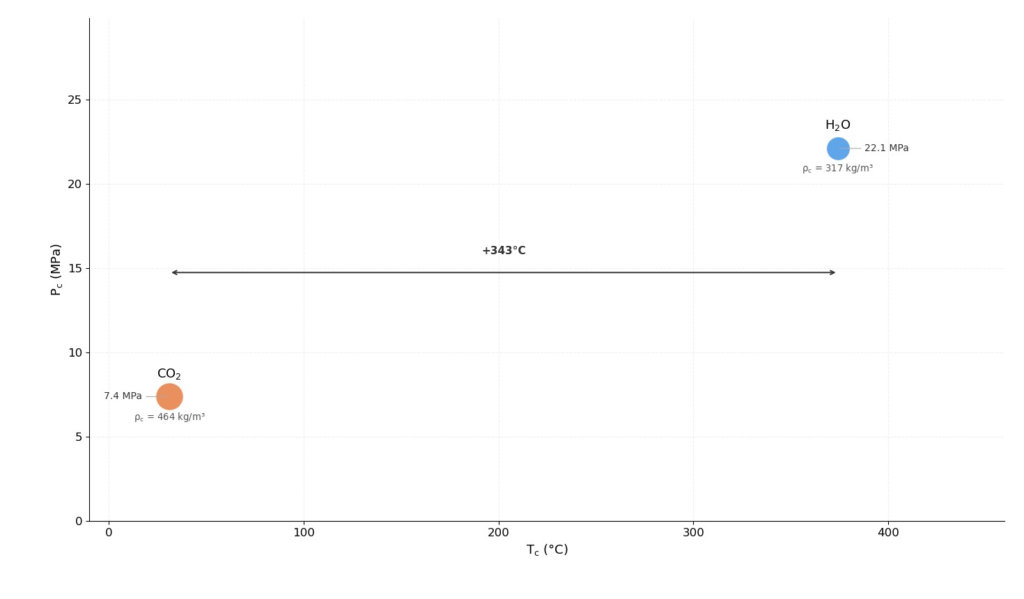
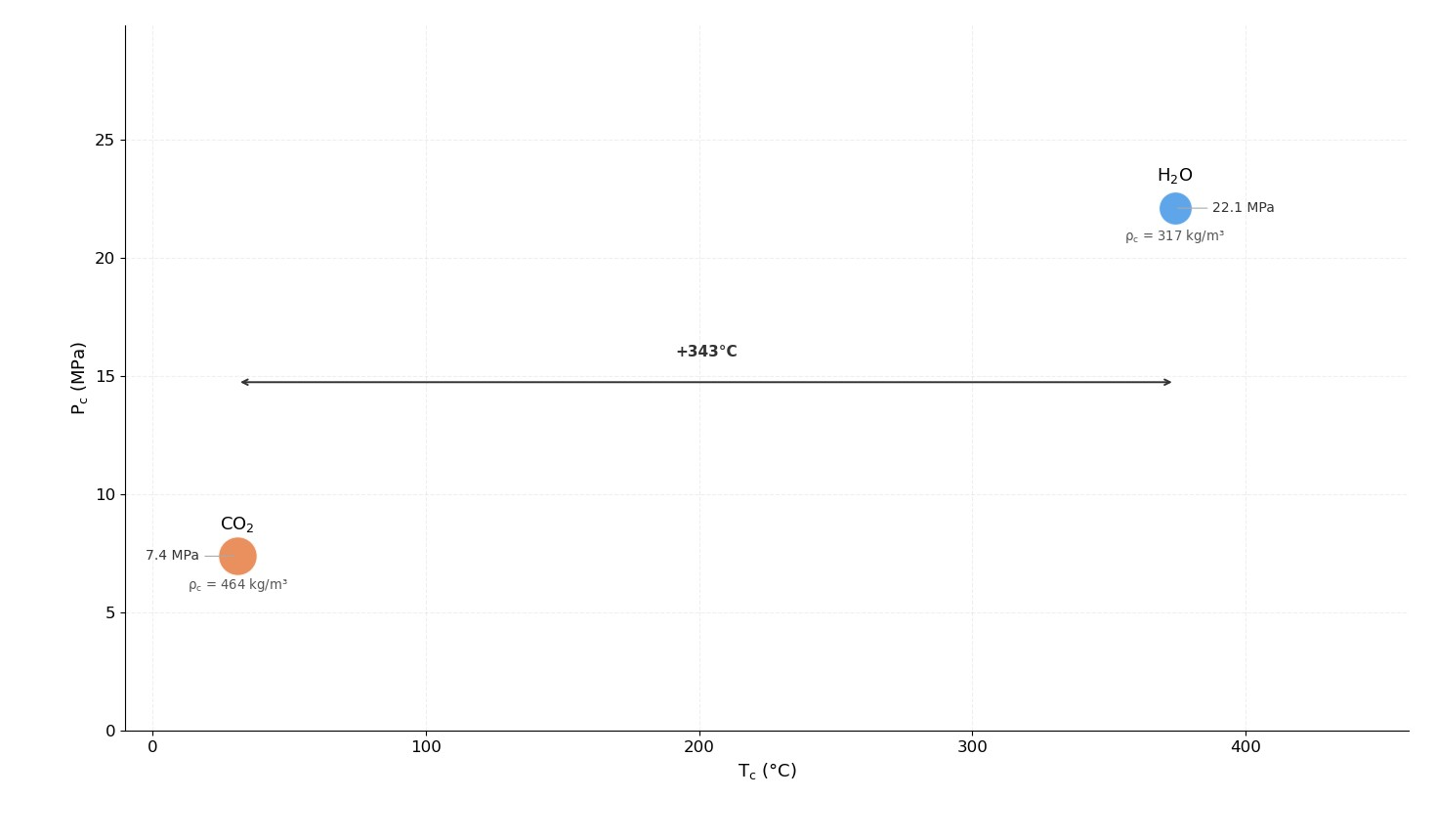
CO2 reaches its critical point at 31°C and 7.4 MPa; water reaches at 374°C and 22.1 MPa (Figure 1). That 343°C gap is the starting point for a fundamentally different engineering proposition.
Because CO2 goes supercritical near ambient temperature, it enters the compressor in a dense, liquid-like state. This is the same intuition behind pump-versus-compressor selection in any process plant: specific compression work scales inversely with fluid density. At 32°C and 8 MPa, sCO2 has a density of 550 to 652 kg/m³, roughly 65% of liquid water’s density, while behaving rheologically like a gas.[5] In a recompression Brayton cycle, the main compressor consumes about 18% of gross turbine output. A conventional gas turbine compressing air uses roughly 40 to 60%.[6] That difference in compression parasitic load goes directly to net power output.
DOE and national laboratory analysis puts the efficiency crossover at a turbine inlet temperature of approximately 425°C. Above that threshold, the recompression closed Brayton cycle (RCBC) outperforms steam Rankine.[7] That temperature encompasses advanced nuclear designs and most combined-cycle gas applications, which means sCO2 is relevant to the bulk of what is being built, not just a niche edge case.
The turbomachinery compactness follows directly from fluid density. The STEP demonstration turbine illustrates the scale. A three-stage rotor weighing roughly 210 lbs delivers a design gross shaft power of 16 MW at 26,640 RPM at the Phase 2 design point, approximately 21,000 horsepower (hp) from a package similar in physical size to an automotive V-8 engine. That output is comparable to roughly 30 NASCAR racing engines. The resulting power density of ~100 hp/lb places the rotor closer in character to rocket engine turbopumps than to conventional ground-based power turbines.[9] At the turbomachinery block alone, that is roughly one-tenth the size of an equivalent steam turbine. Sandia National Laboratories analysis extends the comparison to the full power conversion system, including recuperators and gas cooler, and puts the overall sCO2 system at roughly 30 times smaller than an equivalent steam system.[7] This compactness translates directly into lower capex and reduced construction costs.
sCO2 cycles are also configurable for dry cooling, eliminating the water demand associated with steam condensation. For water-stressed regions, that converts a hard siting constraint into a design parameter. And the cycle architecture is heat-source agnostic: it works with nuclear heat, gas turbine exhaust, concentrating solar, and industrial waste heat.
| Cycle | Realistic Efficiency | Notes |
|---|---|---|
| Conventional steam Rankine | 33–37%[1] | Standard nuclear, industrial |
| Ultra-supercritical steam | 42–45%[3] | State-of-the-art, demanding materials |
| Recuperated sCO2 Brayton | 38–42%[8][9] | Waste heat recovery |
| Recompression sCO2 (RCBC) | 45–50%[8][9] | Nuclear, CSP, gas above 425°C |
| Allam-Fetvedt (oxy-combustion sCO2) | 55–59%[10] | Natural gas with inherent CO2 capture |
Lock-In
In October 2024, the STEP demonstration project completed Phase 1 testing. STEP is a $169 million collaboration between GTI Energy, Southwest Research Institute, GE Vernova, and DOE. Phase 1 ran a simple cycle sCO2 Brayton configuration: single compressor, turbine, recuperator, and cooler. The plant generated approximately 4 MWe net, with about 8 MW of gross shaft power, at full turbine speed, 500°C turbine inlet, and 250 bar.[11] Phase 2 is reconfiguring the plant to a recompression Brayton cycle targeting 715°C and greater than 50% efficiency.[9] NET Power’s Allam-Fetvedt cycle Project Permian, a 300 MW plant near Odessa, Texas, completed FEED in late 2024 and is now in post-FEED value engineering, with commissioning targeted no earlier than 2029.[12] First-of-kind plant deployments follow a well-documented cost escalation pattern that compresses as supply chains mature and procurement pathways standardize. Permian is the current data point for what that looks like in sCO2.
The engineering challenges are specific and well-characterized. High rotational speeds (20,000 to 30,000 RPM versus 3,000 to 3,600 RPM for large steam turbines) impose severe demands on bearings and seals. At supercritical pressures, sCO2 has gas-like viscosity with liquid-like density and will exploit any leak path; commercial seal performance targets have been among the more persistent development problems.[13] At elevated temperatures, CO2 promotes carburization in iron-based alloys, driving material selection toward expensive nickel superalloys whose thin-wall behavior in printed circuit heat exchangers requires validation independent of bulk coupon data. Compressor performance near the critical point is sensitive to ambient temperature, which is a site-selection consideration that steam cycles do not face.
These specific and well-characterized problems are not fundamental physics barriers that end programs. STEP exists to work through them at scale. Phase 1 confirmed that an indirect sCO2 Brayton cycle can be operated at design conditions and grid-synchronized at scale. What the program needs is the runway to complete Phase 2, the recompression configuration on which the efficiency case actually rests, and to extend toward utility scale beyond it.
The broader issue is timing. New nuclear plants are being designed now. Small modular reactors are moving toward commercial deployment in this decade. Private nuclear fusion companies are targeting grid-connected demonstration in the early 2030s, with power conversion efficiency a central design variable. Gas turbine procurement lead times already exceed three years. Every asset contracted in this environment will operate for 30 to 50 years, and the conversion technology specified at design stage is rarely revisited.
The default path is steam. Procurement standards, supply chains, and regulatory pathways are built around it. Choosing sCO2 means navigating unfamiliar territory across equipment sourcing, permitting, operations, and maintenance, without any policy signal that the effort is recognized. Each individual decision is locally rational. The aggregate outcome is that a generation of infrastructure gets built without serious consideration of a more efficient alternative.
The IEA estimated global electricity sector investment at $1.5 trillion in 2025.[14] A five-percentage-point improvement in conversion efficiency across new U.S. thermal generation, sustained across the buildout, is the functional equivalent of additional generation capacity at near-zero marginal cost.
What Changes This
The interventions needed here are specific. sCO2 does not need a mandate. It needs a policy environment that stops making steam the path of least resistance by default.
The most immediate lever is extending STEP toward utility scale. Phase 1 validated the simple cycle configuration at 4 MWe under design conditions. That is not enough to move procurement decisions. A commitment to 100 MW or larger demonstration generates the operational data, supply chain signal, and equipment manufacturer confidence that actually does. DOE has the infrastructure. The program needs sustained budget commitment past the current phase. Atlas can contribute by convening utility, equipment manufacturer, and federal stakeholders around what utility-scale demonstration requires.
The second intervention is adding a conversion efficiency signal to generation incentives. The Production Tax Credit, Investment Tax Credit, and advanced nuclear tax credits reward what fuel a plant burns. A nuclear plant running at 33% thermal efficiency and one running at 50% collect the same credit per kWh sold. An efficiency adder for thermal assets exceeding a defined threshold would change the calculus directly. That is the language to push for. Atlas can contribute through technical analysis on threshold design and through engagement with the staff drafting the relevant tax legislation.
Federal procurement is the third lever. Military installations and federal facilities don’t explicitly require steam, but qualification frameworks, operational standards, and contracting norms were built around it, and the practical effect is the same. sCO2 has no established pathway through existing procurement structures. Shifting to outcome-based specifications, targeting efficiency rather than technology categories, creates that pathway and produces the operational data that accelerates broader adoption. Atlas can contribute by developing model outcome-based specification language for federal procurement officers to adapt.
Supply chain depth is the fourth requirement, and the one most likely to be underestimated. Turbomachinery, printed circuit heat exchangers, and sealing systems for sCO2 cycles come from a limited supplier base with shallow domestic manufacturing. The cost premium this imposes on first-of-kind projects is real and quantifiable. We need a public map of where those gaps are and what targeted investment closes them. That study needs to exist. Atlas can commission and publish that analysis.
We need to acknowledge the pattern. The U.S. developed the foundational sCO2 research. Chaotan One started commercial operation in December 2025. CNNC (China National Nuclear Corporation) reports over 85% higher generation efficiency and more than 50% higher net power output compared to conventional waste-heat steam systems at comparable scale.[15] Japan, South Korea, and the EU have active programs.[16] We have watched U.S.-origin technology reach commercial deployment abroad first (solar, batteries). The window to avoid repeating it in power conversion is open. It will not stay that way.
Conclusion
America’s generation buildout is moving fast and the stakes are real. Getting the source mix right matters. So does the conversion layer, and right now it is not getting the same attention as generation.
The conversion step determines how much useful output comes from every dollar of generation investment, every unit of nuclear fuel, every cubic foot of gas burned. sCO2 power cycles are demonstrated, applicable across the full range of thermal generation technologies in the buildout pipeline, and compatible with the siting constraints that steam increasingly is not. The engineering challenges are known and tractable. The policy barriers are within reach to be addressed.
The plants being contracted today will run until 2070. The conversion technology written into those designs is a 50-year decision. The policy mechanisms exist. The technology is ready. What is missing is the recognition that the conversion layer is a strategic choice.
References
- U.S. Energy Information Administration and EIA. Electric Power Annual 2024. Technical report, October 2025.
- Peter Linstrom. NIST Chemistry WebBook, NIST Standard Reference Database 69, 1997.
- J Tominaga. Steam turbine cycles and cycle design optimization: advanced ultra-supercritical thermal power plants and nuclear power plants. In Advances in Steam Turbines for Modern Power Plants, pages 41–60. Elsevier, 2022. ISBN 9780128243596. doi:10.1016/b978-0-12-824359-6.00015-9.
- U.S. Geological Survey. Total water use in the United States. https://www.usgs.gov/water-science-school/science/total-water-use-united-states.
- Roland Span and Wolfgang Wagner. A new equation of state for carbon dioxide covering the fluid region from the triple-point temperature to 1100 K at pressures up to 800 MPa. Journal of Physical and Chemical Reference Data, 25(6):1509–1596, 1 November 1996. ISSN 0047-2689,1529-7845. doi:10.1063/1.555991.
- Brian Pettinato, Rainer Kurz, Leonid Moroz, Zahroof Mohamed, Sebastian Freund, Bernhard Winkelmann, and Enver Karakas. Machinery basics. In Machinery and Energy Systems for the Hydrogen Economy, pages 31–94. Elsevier, 2022. ISBN 9780323903943. doi:10.1016/b978-0-323-90394-3.00008-4.
- Steven A Wright, Thomas M Conboy, and Gary E Rochau. Supercritical CO2 Power Cycle Development Summary at Sandia National Laboratories, 2011.
- Charles White. Analysis of Brayton cycles utilizing supercritical carbon dioxide. Technical report, National Energy Technology Laboratory, 1 July 2014.
- William W Follett, IV, Jeffrey Moore, Jon Wade Sylvain, Pierre Manager, Mr Follett, and Mr Jonathan Wade. The STEP 10 MWe sCO2 pilot installation and commissioning status update. https://sco2symposium.com/proceedings2024/74-paper.pdf.
- R J Allam, Miles R Palmer, G William Brown Jr, Jeremy Fetvedt, David Freed, Hideo Nomoto, Masao Itoh, Nobuo Okita, and Charles Jones Jr. High efficiency and low cost of electricity generation from fossil fuels while eliminating atmospheric emissions, including carbon dioxide. Energy Procedia, 37:1135–1149, 2013. ISSN 1876-6102. doi:10.1016/j.egypro.2013.05.211.
- STEP Demo pilot plant achieves full operational conditions for Phase 1 of testing. https://www.swri.org/newsroom/press-releases/step-demo-pilot-plant-achieves-full-operational-conditions-phase-1-of-testing.
- Net Power reports fourth quarter 2024 results and provides business update. https://ir.netpower.com/resources/press-releases/detail/37/net-power-reports-fourth-quarter-2024-results-and-provides-business-update.
- Mark Anderson, Greg Nellis, and Michael Corradini. Materials, turbomachinery and heat exchangers for supercritical CO2 systems. Technical report, Univ. of Wisconsin, Madison, WI (United States), 30 October 2012.
- International Energy Agency. World Energy Investment 2025. https://www.iea.org/reports/world-energy-investment-2025, June 2025.
- CGTN. World’s 1st commercial supercritical CO2 power unit starts in China. https://news.cgtn.com/news/2025-12-20/World-s-1st-commercial-supercritical-CO-power-unit-starts-in-Guizhou-1JfNyqa8C1a/p.html, 20 December 2025.
- SETIS – Strategic Energy Technology (SET) Plan Governance. https://setis.ec.europa.eu/index_en, November 2025.
About the Author

Rashad Ahmadov is a PhD candidate in Chemical Engineering at the Laboratory for Laser Energetics, University of Rochester. His research spans heterogeneous catalysis and nuclear fusion, with peer-reviewed publications across chemical engineering and material science. He holds process engineering experience across refining and petrochemicals.
Disclaimer: This paper is published as opinion research authored by a named contributor. It represents the views of the author and does not constitute an official policy position of the Institute for American Manufacturing & Technology, its leadership, or its board.