America is reindustrializing again. You've seen the announcements and the ribbon cuttings, many of them backed by federal laws like the CHIPS Act of 2022.1 You've also heard about the worker shortage. Welders, machinists, electricians. That shortage is real. But the trades aren't the shortage that decides whether a new plant turns into a real business or stays an expensive building.
I learned this three times. At 20, I joined two other engineers, all of us under 30, to build a hydraulic pump and motor factory on an empty floor. We spent a year putting the whole plant on paper. Processes, drawings, supply, layout, staffing, and how each department would work with the others. We spent the next year building it. That plant still runs. At 30, a colleague and I bought into a failing metalworking and transformer factory and brought it back to profit in 18 months. Now I'm building a new electrical equipment plant from scratch.
None of us had decades of experience. What we had was a working model of how a factory functions as one system, and we followed it. You can buy a machine. You can't buy a plant where everything fits together. The process has to fit the layout. The supply has to fit the schedule. The cost has to fit the price. And somebody has to answer the plain question nobody asks, which is who is responsible for what. Most of the industry has no model for any of this. What it knows lives in the heads of people who have built plants before. The industry even has a name for it, tribal knowledge – sounds mystical. So each new plant gets rebuilt from memory, spreadsheets, and consultants who tune modules that do not share a language. The engineers I hire are good specialists. Few of them were ever taught to treat the whole factory as the product.
Medicine faced this problem once. For centuries, doctors learned from respected texts and from each other. Then anatomy gave them a shared map of the body, with a name for every part and an account of how each system works with the others.
Engineers have the same thing for machines. An engine handbook gives you a diagram of how the engine is built, formulas that predict how it will perform, and a standard name for every part. With those three things, you can design an engine on paper and expect it to run the way you planned.
A factory has no such map, and it should pass the same three tests. A diagram that shows how sales, production, supply, and finance fit together, down to the single workstation where a person, a machine, and the skill to run it meet. Formulas that let you plan and simulate the plant's future, not just report its past. And one set of names that a buyer, a planner, and an investor all use to mean the same thing.
The closest thing we have to a standard model of a company is double entry bookkeeping, which Luca Pacioli set down in 1494.2 Every company must use it, and it works. But it tells you what happened last month. It has no diagram of how the plant runs, and it cannot simulate next year. Planning a new plant on accounting alone is like driving by the rearview mirror.
And the people who carry what working knowledge we have are leaving. U.S. manufacturing employment peaked at 19.6 million in June 1979. In August 2026 it was about 12.6 million. As a share of all nonfarm jobs, it fell from about one job in five to about one in thirteen.3 The money is coming back. The people who knew how to turn money into a working factory aren't.
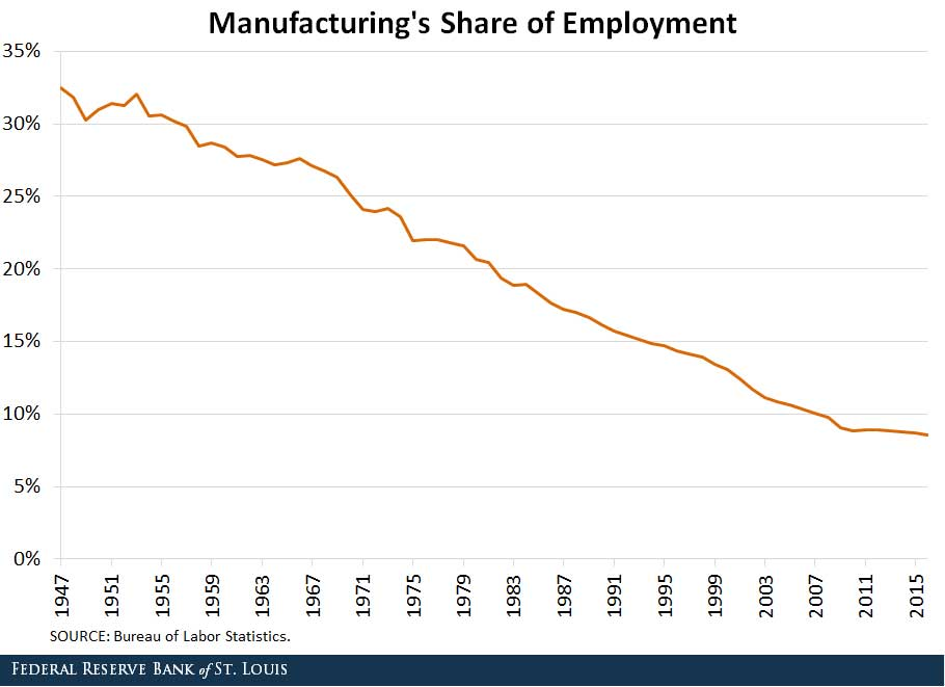
Figure 1. Manufacturing's share of U.S. employment, 1947 to 2015. Chart by the Federal Reserve Bank of St. Louis from Bureau of Labor Statistics data.
The last time America worried this hard about its factories was 1980, the year Japan built about 11 million vehicles to America's 8 million.4 It had faced the knowledge problem long before that. In 1886, Henry Towne told the American Society of Mechanical Engineers that the management of works "is unorganized, is almost without literature, has no organ or medium for the interchange of experience."5 What followed came in three waves. Towne and Frederick Taylor led the first and turned shop management into a subject you could study.6 Walter Shewhart, W. Edwards Deming, and Joseph Juran led a second wave on quality, and Japanese industry adopted their methods widely. Joseph Orlicky and Oliver Wight led a third in the 1970s and 1980s with MRP, which tied sales, production, supply, and finance into one plan.7
Each wave made plants better. None finished the job. Deming's flow diagram shows how production works but leaves out the money.8
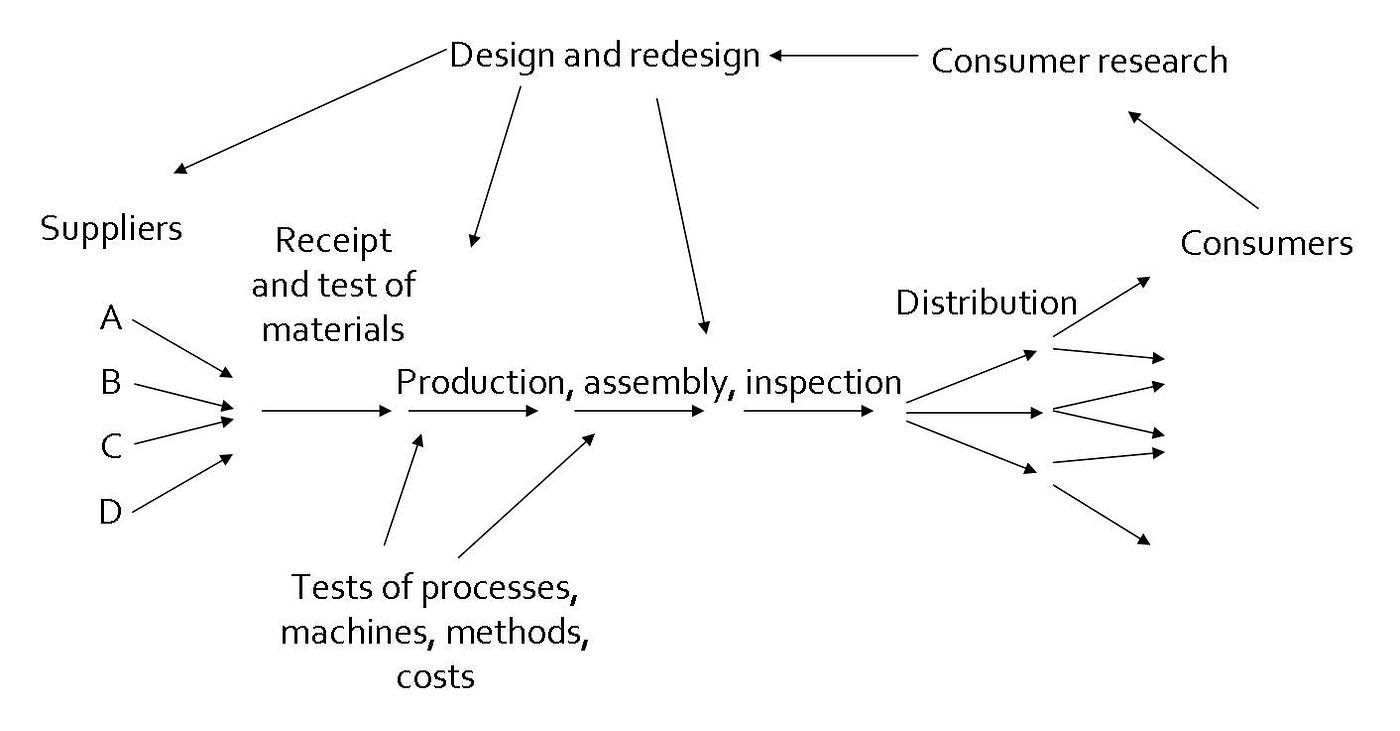
Figure 2. Deming’s flow diagram of production viewed as a system. See note 8.
MRP II includes the money but leaves out the people and what they need to know. In 1981, Wight still found "virtually no college textbooks that address the subject from a practical viewpoint."7 Around the same time, as Wight recounted, Wickham Skinner of Harvard Business School argued that companies saw manufacturing the wrong way at the plant, managed it the wrong way at headquarters, and taught it the wrong way in business schools.7 And every wave aimed at plants that already stood.
In 1980, the job was to fix the factories. Today, a lot of the job is building them anew. Many plants that survived the 1980s didn't survive the offshoring years that followed, and the old guard retired with them. In my experience, the managers our schools turn out are trained for a service economy, not a factory floor.
Here is the problem in plain terms. America is financing capacity as if the missing inputs were capital and permits. The real missing input is a teachable model of the factory. It has to explain how the factory works as a system for making things, and how its people share responsibility for keeping it running.
Think about what it takes to stand up a plant. Someone has to decide how the process flows, how the floor is laid out, where supply comes from, what each unit costs, and who owns each decision. Get them wrong, and you build a plant that only survives on grants, contracts, or the next funding round.
Few people can make those choices together. This shortage is far smaller than the one in the trades, but it matters more. Without these people, the welders and machinists we train have no working plant to walk into.
The fix follows the method the first three waves used. Build the knowledge, test it, and teach it widely.
First, build the model the way engineers build anything, and test it. ASME, where Towne and Taylor started this work, should lead a program to write a reference model of the manufacturing plant, with NIST funding through the Manufacturing Extension Partnership.9 The model should come from real plants and go back into real plants. Pilot factories would use it to plan launches and turnarounds, and only what works there gets published.
Second, put it in software and in the classroom. ABET already requires industrial engineering graduates to design integrated systems of people, materials, information, equipment, and energy, and manufacturing engineering programs must cover manufacturing systems design.10 In the programs I have seen, though, capstones take the firm as given and design a line or a layout inside it. A model with formulas changes that. It can run as a digital twin of the business, the way machining software simulates a job before a single part gets cut. Students could design a full plant on screen, change the product mix or a supplier, and watch cost and schedule move. In my experience, young engineers trained on a working model can start building plants in months.
Third, make it a standard. Machines run on standards from ASME, ISO, and IEEE. Plant management has none. Once the model is proven, ASME can publish it as a standard, and IISE can carry it into the industrial engineering curriculum it already oversees. Federal awards for new plants from Commerce, Defense, or Energy can then require a plant design built to that standard.
If we do this, a new plant becomes a design you can check before you fund it. Investors and agencies can read the plan in the same terms the engineers use. And every funded plant trains the people who build the next one.
If we don't, America will keep paying for buildings that run on borrowed time. Want to test how thin this knowledge is? Ask an engineer you trust to sketch how a factory earns money as one system, from process to supply to cost to who answers for each. Then ask where they learned it. You can't reindustrialize a country that has forgotten how to design a plant.
Notes
1. CHIPS Act of 2022, enacted as Division A of the CHIPS and Science Act, signed August 9, 2022.
2. Luca Pacioli, Summa de Arithmetica, Geometria, Proportioni et Proportionalita (Venice, 1494), section on accounts and records.
3. U.S. Bureau of Labor Statistics, Current Employment Statistics, series CES3000000001 (All employees, manufacturing) and CES0000000001 (All employees, total nonfarm), seasonally adjusted.
4. Japan Automobile Manufacturers Association, historical motor vehicle production statistics, 1980.
5. Henry R. Towne, "The Engineer as an Economist," Transactions of the American Society of Mechanical Engineers, volume 7 (1886).
6. Frederick W. Taylor, The Principles of Scientific Management (Harper and Brothers, 1911).
7. Oliver W. Wight, MRP II: Unlocking America’s Productivity Potential (Oliver Wight Limited Publications, 1981). The textbook passage is quoted with a reference to p. 7 in Stefan T. Stefanov and Trifon T. Stefanov, “Restoring the Prestige of the Engineering Education” (2022), p. 1675 and reference 8. See also Joseph Orlicky, Material Requirements Planning (McGraw Hill, 1975).
8. W. Edwards Deming, Out of the Crisis (MIT Center for Advanced Engineering Study, 1986), flow diagram of production viewed as a system.
9. National Institute of Standards and Technology, Hollings Manufacturing Extension Partnership and Manufacturing USA program documentation.
10. ABET, Criteria for Accrediting Engineering Programs, program criteria for industrial and similarly named engineering programs (lead society IISE) and for manufacturing and similarly named engineering programs (lead society SME).
About the author

Stefan Stefanov is a manufacturing engineer and chairman of the Institute for Systemic Economic Engineering (ISEE) in Sofia. ISEE is developing an open model of the manufacturing enterprise and related software. He has spent his career using that model to start up and turn around machine-building plants. He is the author of Zero to Industry: Unlocking the Next Industrial Revolution and has presented ISEE’s work on plant-as-system design at ASME IMECE and IEEE EDUCON. He chairs the ASME Bulgarian Section and is an organizational secretary for the ASME Management Division.
Stefan Stefanov — contributor profile · LinkedIn · X · ISEE
Disclosure
Stefan Stefanov is chairman of ISEE, a Bulgarian for-profit institute that develops and teaches an open model of the manufacturing enterprise (Business Model Ontology) and related software (Business Digital Twin). ISEE would benefit if public agencies or professional societies funded, hosted, or credentialed a shared body of knowledge on plant design of the kind this commentary recommends.
This article is independently authored commentary. The views and opinions expressed are those of the author and do not necessarily reflect those of the Institute for American Manufacturing & Technology, its board, advisors, or staff. Publication does not constitute an endorsement of any company, product, or service mentioned.